- About the Center
- About Neutrinos (Coming Soon)
- Members
- Experimental Research
- Theory Research
- Seminars
- Conferences & Workshops
- Kimballton Lab
- Publications
- CNP in the News
- Job Opportunities
- Internal
- Physics Department
- College of Science
The U.S. Department of Energy's Office of Science
The National Science Foundation
The National Nuclear Security Administration

Center for Neutrino Physics
Featured Items
Rebekah Pestes Wins the 2020 Scharff-Goldhaber Prize
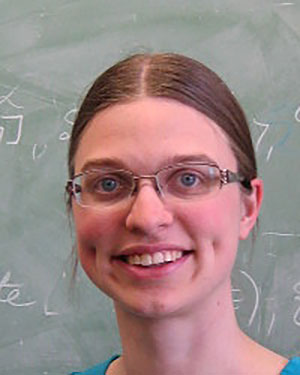
CNP graduate student, Rebekah Pestes, has been awarded the 2020 Gertrude Scharff-Goldhaber Prize, consisting of $2,500 and a certificate. The award was established in 1992 by Brookhaven Women in Science, a nonprofit organization that supports and encourages the advancement of women in science. The award ceremony will be held online on Thursday, July 9, at 1 p.m. at which Pestes will give a talk about her work, "Investigating Important Considerations for Neutrino Oscillation Experiments." This event is free and open to the public.
The award recognizes substantial promise and accomplishment by female graduate students in physics who are enrolled in the graduate program at Stony Brook University and/or performing their thesis research at Brookhaven Lab, and commemorates the outstanding contributions of the late nuclear physicist Gertrude Scharff-Goldhaber. In 1950, Scharff-Goldhaber became the first female Ph.D. physicist appointed to the Brookhaven Lab staff. She was also a founding member of BWIS.
At Virginia Tech, Pestes' works with Prof. Patrick Huber, her research focuses on neutrino phenomenology. She is currently working at Brookhaven National Laboratory with Peter Denton as a part of the DOE's Science Graduate Student Research Program.
|
| Rebekah Pestes |
Antarctic Neutrino Anomaly Explained by Prof. Shoemaker
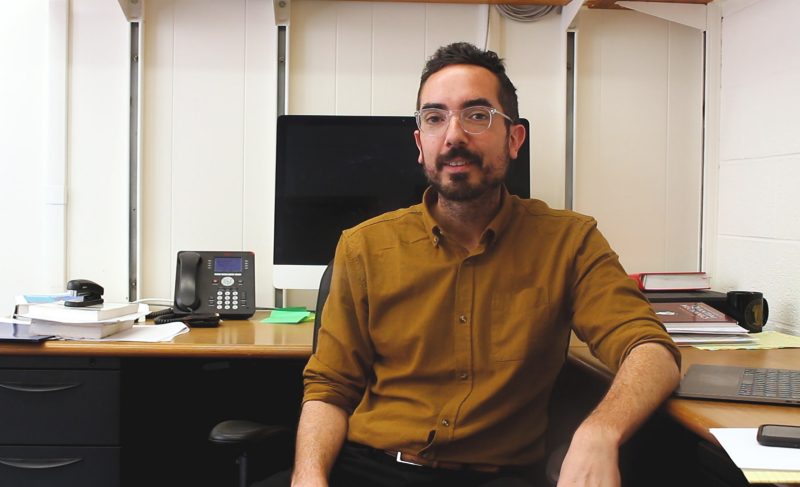
A new research paper co-authored by a Prof. Ian SHoemaker and appearing in thw Annals of Glaciology provides a new explanation for two recent strange events that occurred in Antarctica - debris from apparent high-energy neutrinos appearing to come up out of the Earth on their own accord and head skyward.
The events were discovered by scientists at the ANITA experiment in the South Pole. Scientists remain perplexed by the activity, with some 40 papers so far giving wildly different answers. "We think sub-surface firn is the culprit," said Shoemaker, adding that "firn is something between snow and glacial ice. It's compacted snow that's not quite dense enough to be ice. So, you can have density inversions, with ranges where you go from high density back to low density, and those crucial sorts of interfaces where this reflection can happen and could explain these events."Shoemaker added that, "When cosmic rays, or neutrinos, go through ice at very high energies, they scatter on materials inside the ice, on protons and electrons, and they can make a burst of radio, a big nice radio signal that scientists can see. The problem is that these signals have the radio pulse characteristic of a neutrino, but appear to be traversing vastly more than is possible given known physics. Ordinary neutrinos just don't so this. But cosmic rays at these energies are common occurrences and have been seen by many, many experiments."
|
| Prof. Ian Shoemaker |
Professor Horiuchi Solves Dark Matter Mystery
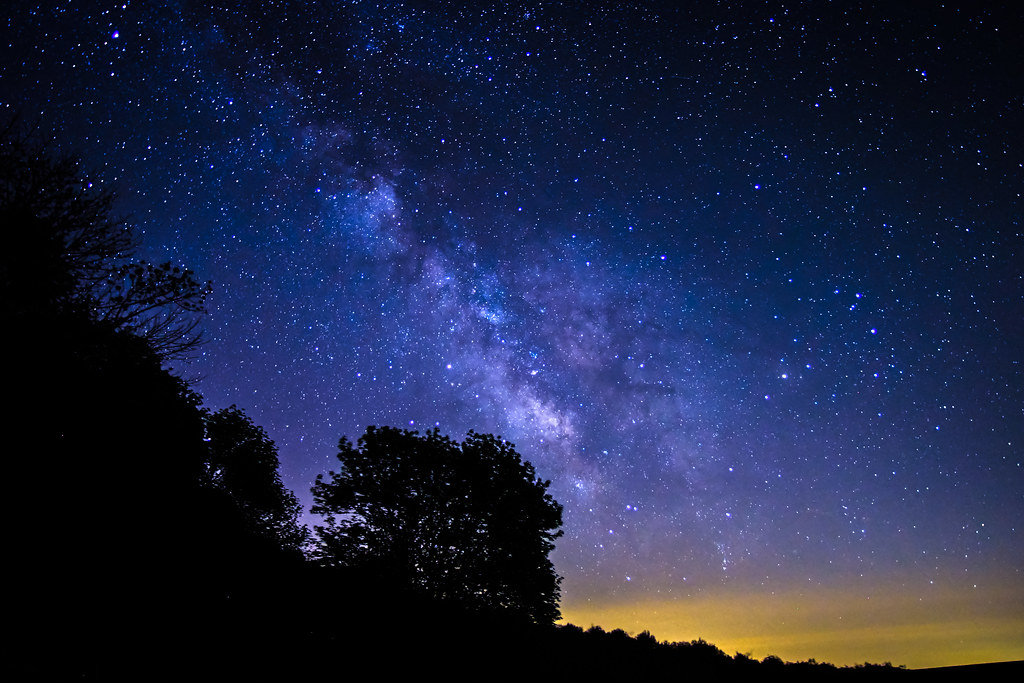
A new research paper co-authored by Prof. Shunsaku Horiuchi and appearing in the journal Physical Review D has strongly ruled out the possibility that dark matter physics is behind a mysterious excess of gamma rays from the center of the Milky Way galaxy.
The mysterious gamma-ray signal was detected more than a decade ago by NASA's Fermi Gamma Ray Space Telescope, which convinced some physicists that they were seeing evidence of the annihilation of dark matter particles. However, many sources of gamma rays crowd the field, from star-formation activity to high-energy outflows and pulsars. "We looked at all of the different modeling that goes on in the Galactic Center, including molecular gas, stellar emissions and high-energy electrons that scatter low-energy photons," said co-author Oscar Macias, a former postdoctoral scholar at Virginia Tech's Center for Neutrino Physics and now joint postdoctoral researcher at the University of Tokyo and the University of Amsterdam. Horiuchi explained that especially crucial was the distribution of stars which is shaped like a bar in the Galactic Center, rather than symmetric as expected from dark matter. By including these in the analysis, the authors were able to strongly exclude the dark matter explanation, and set the strongest constraints yet on the properties of the most popularly theorized models of dark matter.
|
CUORE Sets New Limits on Neutrinoless Double Beta Decay
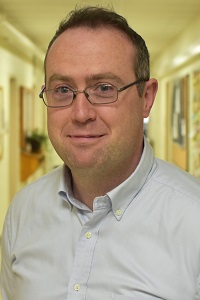
The CUORE Collaboration, with Virgina Tech professor Thomas O'Donnell, published new limits on the the neutrinoless double beta decay of the 130Te isotope in Physical Review Letters. Based on an accumlated 372.5 kg years of data, these new results extend the limit on the neutrinoless double beta decay half-life of 130 to greater then 3.2x1025 years, and limit the effective Majorana mass to less then 75 to 350 meV, depending on the nuclear matrix element.
After a period of detector maintenance and optimization, CUORE is stably collecting data at a rate of 50 kg years/month. The experiment is a proof of the power and scalability of the bolometric technique to the ton scale. Recent developments in scintillating crystals demonstrate the technology for a future zero-background search. These advances will be exploited in the next generation bolometric experiment, CUPID, which will reuse the CUORE cryostat and infrastructure.
|
| Prof. Tommy O'Donnell |
News & Events